
 By Daniel Mercer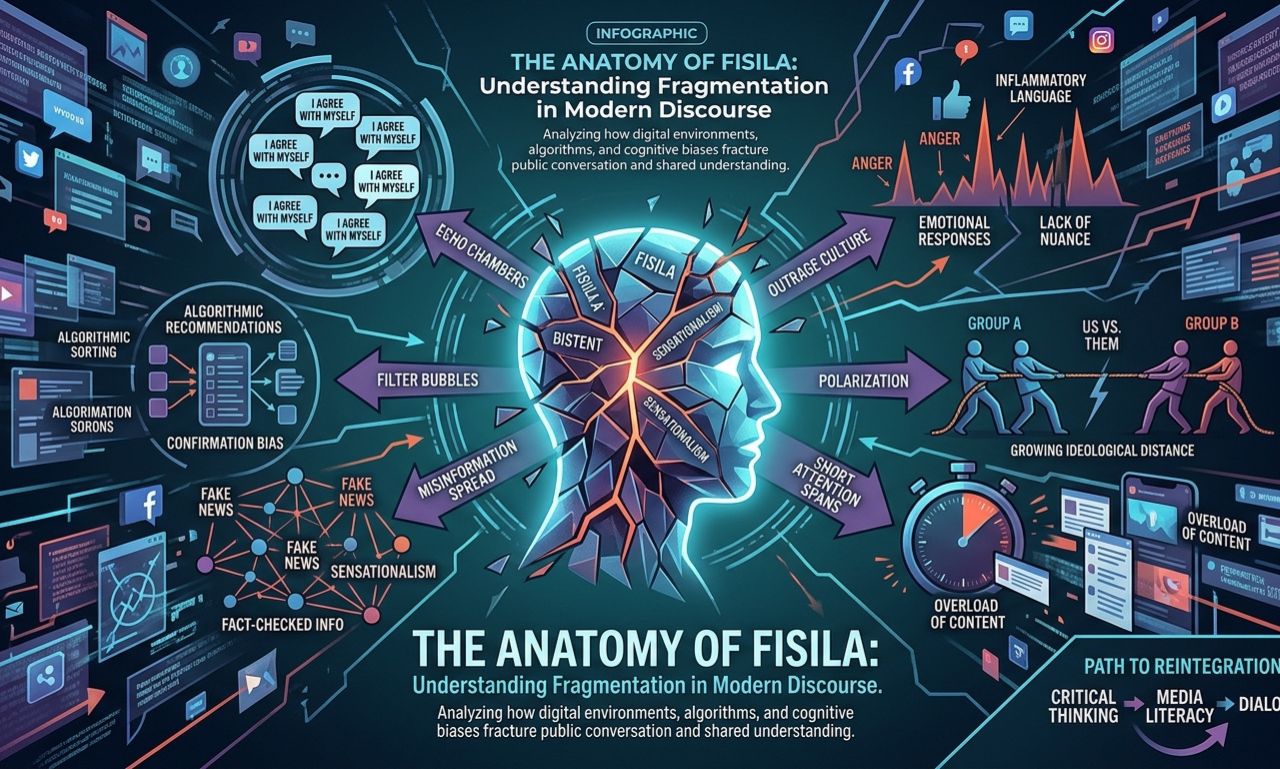
The word fisila carries a weight that transcends simple dictionary definitions. Originating from classical linguistic frameworks, fisila generally refers to a state of fragmentation, division, or the act of breaking down a cohesive whole into smaller, often disjointed, parts. While the term might sound archaic to some, its relevance in contemporary society is startlingly acute. To explore fisila is to examine the cracks in our collective foundations—whether in political parties, digital echo chambers, or personal relationships. In an era dominated by polarized opinions and algorithmic segregation, understanding the mechanics of how wholes become fragmented is not merely an academic exercise; it is a survival skill for social cohesion. This article will dissect the anatomy of fisila, tracing its roots, its manifestations in modern hierarchies, its psychological toll, and potential pathways toward mending the fractures.
Deconstructing Fisila: The Linguistic and Philosophical Roots
Before applying fisila to modern contexts, one must first understand its etymological core. Unlike simple synonyms like “division” or “split,” fisila implies a specific kind of rupture—one that is often irreversible or leads to a qualitative change in the original object. In classical philosophy, fisila was used to describe the moment a single argument fell into fallacious fragments. Think of a potter who drops a clay vessel. The pieces are still clay, but they no longer function as a vessel. That state of being broken beyond original function is the essence of fisila.
This philosophical distinction is crucial. Not all fragmentation is negative; cellular division creates life, and task delegation creates efficiency. However, fisila denotes a destructive fragmentation. It occurs when the parts lose respect for the whole. In Roman political theory, senators warned against fisila populi—the fracturing of the people into warring tribes with no shared value system. Today, we witness this exact phenomenon as national dialogues dissolve into 280-character shouting matches. Recognizing fisila allows us to label the problem accurately: we are not dealing with healthy disagreement but with systematic disintegration of common ground.
The Role of Fisila in Hierarchical Collapse
Historically, every great institution has succumbed to internal fisila before external pressure ever touched its walls. Corporate giants, empires, and religious movements rarely die by assassination; they die by a thousand internal cuts. When we examine organizational failure through the lens of fisila, we notice a predictable pattern. Initially, a unified mission statement holds the group together. Then, a minor ideological crack appears—perhaps a disagreement over resource allocation or ethical priorities. Without a mediating structure, that crack deepens. Subgroups form. Language diverges. One department stops understanding the jargon of another.
This is fisila in action. It is not merely a disagreement; it is the loss of translational trust. For example, in a hospital experiencing fisila, the administration sees “efficiency metrics” while nurses see “patient neglect.” The whole (patient care) fragments into two opposing realities that cannot communicate. Modern management techniques often fail because they treat the symptom (arguing employees) rather than the structural fisila (the broken semantic bridge between roles). To heal a hierarchy, leaders must first map where the fractures began—not with a single event, but with the slow erosion of shared meaning.
Modern Manifestations: Fisila in Digital and Social Spheres
If fisila was a quiet problem in the age of print media, it has become a screaming epidemic in the digital age. Social media algorithms are machines designed to optimize for fisila. Why? Because fragmented content—controversial clips, out-of-context quotes, emotionally charged headlines—generates more engagement than cohesive, nuanced arguments. Every time a user shares a screen-cropped snippet of a longer article without its original framing, they are participating in fisila. The original context (the whole) is destroyed, leaving only a shard of meaning that can be weaponized against the original speaker.
Consider the political landscape. A politician gives a thirty-minute speech on economic policy. Within an hour, six different fisila fragments of that speech are circulating: a two-second clip of a stumble, a data point divorced from its caveats, a facial expression frozen in a misleading screenshot. The whole argument is lost. The audience is left fighting over the pieces. This is the dangerous genius of fisila—it replaces discourse with debris. Furthermore, social fisila extends to identity politics, where individuals are reduced to single attributes (race, gender, orientation) rather than being understood as complex wholes. While categorization can be useful for advocacy, when it hardens into fisila, it forbids dialogue across the fragments.
Psychological Consequences of Living in a Fragmented World
Living under constant fisila has measurable psychological effects. The human mind craves coherence. We are pattern-seeking animals who derive security from narratives that make sense. However, when every news feed, workplace memo, and family dinner conversation is fractured into competing, irreconcilable pieces, cognitive dissonance skyrockets. Chronic exposure to fisila leads to a state researchers call “fragmented attention,” which mimics mild trauma symptoms: irritability, an inability to focus on long-form content, and a defensive posture toward any information that doesn’t immediately fit one’s fragment of the truth.
On a relational level, fisila explains why many modern friendships dissolve not over major betrayals but over a slow accumulation of misinterpreted texts and missed contexts. A sarcastic message sent without a tone indicator is a fragment. The recipient fills in the missing whole with their worst assumptions. Over months, these micro-fractures accumulate until the relationship shatters. Recognizing fisila as a relational force is empowering because it shifts blame from personal malice to structural breakdown. Your friend didn’t “betray” you; a fragment of communication created a false reality. Healing requires rebuilding the whole message, not winning the fragment fight.
Mending the Cracks: Strategies to Counteract Fisila
While fisila is pervasive, it is not invincible. Counteracting fragmentation requires deliberate, often counter-cultural habits. The first strategy is restoration of context. Before sharing a shocking statistic or a damning quote, ask: “What is the missing whole here?” Consciously seek out the original source. This slows the spread of fisila at the individual level. The second strategy is institutional bridge-building. Organizations suffering from internal fis-ila should institute mandatory cross-departmental rotations. When a marketer spends a week in customer service, the fisila between those two worlds begins to heal because shared experience rebuilds the missing links.
On a societal level, reducing fis-ila means redesigning incentives. If we reward nuance over outrage, the market will adapt. Some media platforms are experimenting with “context layers”—pop-up annotations that reattach fragments to their original wholes. Additionally, educational systems must teach dialectical thinking alongside critical thinking. Critical thinking often dissects (creating more fragments), while dialectical thinking synthesizes (building new wholes). A curriculum that honors both can produce citizens resistant to fisila. Finally, on a personal level, practice the discipline of the long read. Every time you finish a 2,000-word article instead of a 280-character tweet, you strengthen your neural resistance to fragmentation. You remind your brain that the whole is not a myth; it is a muscle.
The Future of Unity in an Age of Fisila
Predicting the future of fisila requires honesty about human nature. We will never eliminate fragmentation entirely, nor should we. Dissent, individuality, and even chaos are creative forces. However, the difference between productive diversity and destructive fisila is the presence of a shared framework. A jazz band is not fragmented; every musician improvises, but they follow the same chord progression. Modern society lacks that chord progression. We are improvising in different keys and calling it freedom.
The future belongs not to those who shout the loudest within their fragment, but to those who can translate between fragments. We need a new class of “connectors”—journalists who refuse to crop quotes, managers who build semantic bridges, and friends who ask for context before taking offense. Fisila describes our current condition accurately: a broken vessel. But a broken vessel can be repaired with gold (the Japanese art of Kintsugi). The cracks remain visible, but they are no longer leaks. They become history. Our task, therefore, is not to pretend the fragments don’t exist. It is to hold them together with intention, patience, and the stubborn belief that the whole is worth saving. Understanding fisila is the first step. Acting against it is the second. Do not let the fragments define you. Let the act of mending define the age.