
 By Daniel Mercer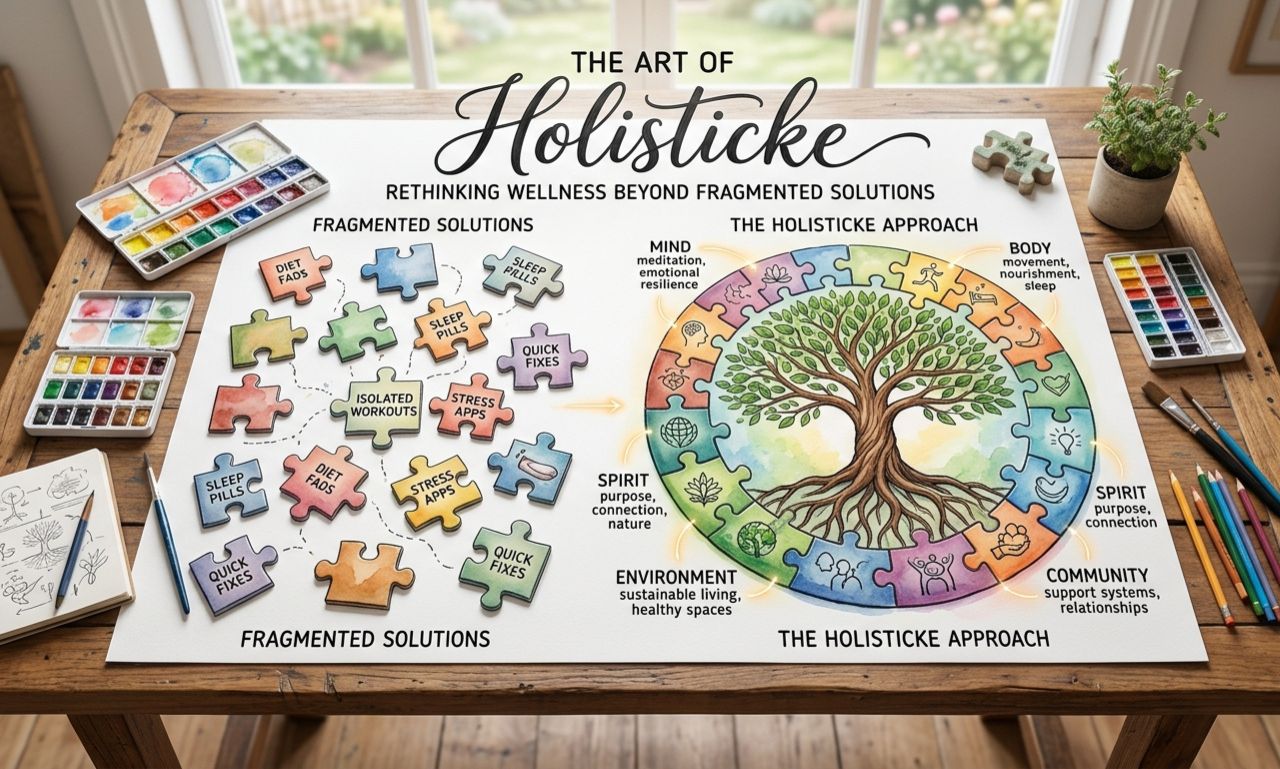
In an age of specialization, where doctors treat organs in isolation and fitness plans ignore mental fatigue, the concept of holisticke emerges not as a misspelling but as a deliberate evolution. The term holisticke challenges the fragmented approach to health by demanding that we see the body, mind, environment, and spirit as a single, pulsating system. While mainstream “holistic” medicine has gained traction, holisticke goes further—it rejects the idea that adding a yoga class to a toxic lifestyle creates balance. Instead, it asks a radical question: What if every symptom is a conversation, and every cure must involve the whole? This article will explore how embracing holisticke principles can rebuild your daily routines, nutritional choices, emotional habits, and even your social connections from the ground up.
What Holisticke Is Not: Correcting Common Misconceptions
Before diving into applications, it is crucial to define holisticke by what it excludes. Standard holistic approaches often fall into the trap of “additive wellness”—keeping a poor diet but adding kale smoothies, or maintaining a stressful job while practicing ten minutes of meditation. Holisticke, in contrast, demands subtractive honesty. You cannot layer peace on top of chaos. The holisticke framework argues that a single unresolved trauma will eventually infect physical health, just as a chronic gut inflammation will alter decision-making abilities. Therefore, holisticke is not a buffet of feel-good practices; it is a surgical reassessment of how you live, work, and relate to others. It requires auditing your relationships, your workspace lighting, your sleep debt, and even your unspoken beliefs about money—because all of these feed into your total system.
The Five Pillars of a Holisticke Lifestyle
To practice holisticke effectively, one must understand its five interconnected pillars. Each pillar supports the others, and neglecting any one collapses the entire structure.
Pillar One: Biological Resonance
The first pillar of holisticke is biological resonance—not simply eating organic or exercising, but aligning your daily rhythms with your unique genetic and microbial makeup. A holisticke approach rejects one-size-fits-all diets. Instead, it encourages tracking how specific foods alter your mood, sleep quality, and skin clarity over a 72-hour window. For example, if wheat makes you anxious three hours later, that is not a “minor sensitivity”; it is a systemic signal. In holisticke practice, you remove that trigger not because of allergies, but because any chronic inflammation disrupts mental and emotional balance. Additionally, biological resonance includes light exposure. A holisticke morning means seeing natural sunlight within thirty minutes of waking, because that single act regulates cortisol, melatonin, and dopamine simultaneously.
Pillar Two: Emotional Ecology
Standard wellness often treats emotions as problems to be managed. Holisticke reframes them as ecological forces within your internal environment. Just as a forest needs both rain and fire, your psyche needs both joy and grief to remain fertile. The holisticke method does not encourage “positive thinking” at the expense of authenticity. Instead, it asks you to map your emotional triggers across a weekly cycle. Do you feel resentment every Sunday evening? That is not a personality flaw; it is data. A holisticke intervention would examine your Sunday schedule, your conversations with family, and even the color temperature of your living room lights. Change the environment, and the emotion follows. This pillar also demands that you stop outsourcing emotional regulation to substances, social media, or compulsive shopping—each of which creates a deeper systemic debt.
Pillar Three: Relational Symmetry
No person exists in isolation. The third pillar of holisticke acknowledges that your closest relationships act as either medicine or poison. A single critical partner can elevate your baseline cortisol more than a high-pressure job. Conversely, a friend who listens without fixing can lower your blood pressure. Holisticke practice involves conducting a “relational audit” every three months. List everyone you interact with weekly. Label each interaction as energizing, neutral, or draining. Then, for draining relationships, apply the holisticke rule: either change the dynamic (by setting boundaries or altering communication patterns) or reduce exposure by 80 percent. This is not selfish; it is systemic self-respect. Remember, a holisticke body cannot heal while absorbing daily micro-stresses from unhealthy relational patterns.
Pillar Four: Environmental Coherence
Your surroundings are not neutral. The fourth pillar of holisticke examines your built environment as an extension of your nervous system. Cluttered spaces fragment attention. Blue light after 8 PM confuses circadian genes. Synthetic fragrances in laundry detergents can trigger low-grade respiratory inflammation that you never consciously notice—but your immune system does. A holisticke transformation begins with small, coherent changes: replace overhead fluorescent lights with warm lamps, introduce three houseplants to improve air quality and visual calm, and commit to a fifteen-minute nightly reset of your living space. Furthermore, environmental coherence extends to digital spaces. Unfollow social media accounts that provoke envy or outrage. Your algorithmic diet is part of your holisticke ecology. If your phone is a source of dread, that dread will manifest as shoulder tension, shallow breathing, and disrupted sleep.
How to Implement Holisticke in Daily Routines
Theory is useless without action. Implementing holisticke does not require a retreat or expensive supplements. Start with your morning. Upon waking, do not reach for your phone. Instead, spend two minutes feeling your pulse and observing your breath. That simple act is holisticke because it connects physical awareness (heart rate) with mental intention (non-reactivity). Next, hydrate with water and a pinch of salt—not because a guru said so, but because your electrolytes directly affect nerve transmission and mood stability. During meals, practice holisticke eating: look at your food, smell it, chew thoroughly, and put down your fork between bites. This single change improves digestion, lowers stress hormones, and often reduces overeating by 20 percent without dieting.
In the workplace, apply holis-ticke by taking a three-minute “system reset” every ninety minutes. Stand up, look out a window (focusing on a distant object to relax eye muscles), and deliberately yawn or sigh. Yawning resets the vagus nerve, which controls your parasympathetic nervous system. That is holi-sticke in action—using a simple physical act to regulate emotional state and mental clarity. Finally, your evening routine must honor holisticke principles by dimming lights two hours before bed, ceasing all work-related thoughts (write them down on paper to “close” the mental tab), and sleeping in complete darkness. Over eight weeks, these small, integrated changes rewire your entire system.
Measuring Progress in Holisticke Practice
Unlike quick-fix solutions, holisticke progress is measured qualitatively, not just quantitatively. Yes, you can track sleep hours, heart rate variability, and mood scores. But the real metric is a felt sense of coherence—the experience that your actions, values, and physical sensations are no longer at war. A successful holisticke life feels less exhausting. Problems do not disappear, but your capacity to hold them without collapsing increases. You might notice that arguments with your partner resolve faster, or that a cold passes in three days instead of ten. These are signs that your system has stopped fighting itself. And that, ultimately, is the promise of holisticke: not perfection, but a deep, resilient wholeness.